

Private Law in Crisis: From Doctrine to Policy ALSA Private Law Conference, City University of Hong Kong, 28–29 May 2026
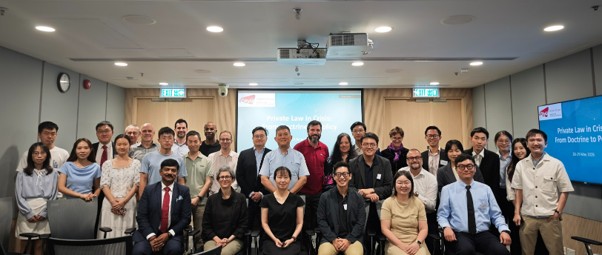
The Private Law Chapter of the Asian Law Schools Association (ALSA), co-hosted with the City University of Hong Kong School of Law, hosted its inaugural conference on 28 and 29 May 2026, bringing together established and early-career scholars to examine a deceptively simple but hitherto under-explored question: what role does private law play in times of crisis? Recent years have delivered an unprecedented run of crises—pandemics, climate change, economic instability, misinformation, and technological disruption—that strain the traditionally bilateral, individualistic vocabulary of torts, contracts, restitution, property, and equity. The conference asked whether such macro-scale, poly-centric problems lie beyond private law’s remit, or whether they instead demand creative reworking of traditional concepts, alongside novel and more reformist schemes of regulation, collective redress, and loss-spreading.
Convened under the theme “Private Law in Crisis: From Doctrine to Policy,” the event was organised by a committee led by Professor Carrie Ding and Associate Professor Chen Yang, (CityUHK) as well as Associate Professor Zhong Xing Tan, Assistant Professor Hu Ying and Assistant Professor Tan Weiming (NUS), with an advisory panel including Professors Tan Cheng Han (NUS), Lusina Ho (HKU), and James Penner (NUS).
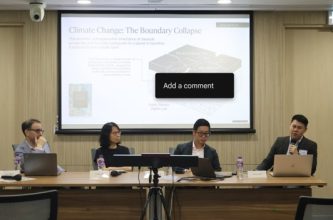
The keynote panel set the tone with a series of searching questions on the state of the field, prompted by the disruptions taking place all over the world and presenting challenges to legal academia more generally. Professor Ernest Lim argued that artificial intelligence and climate change have compelled us to think beyond the atomistic models of private law that doctrinalists are so familiar with. Professor Jodi Gardner offered the view that ‘crisis’ can be understood as more opportunity than challenge, productive in its potential to encourage greater diversity, collaboration, and engagement with real-world problems. Professor Dan Priel presented a provocative thesis that private law parallels evolutionary biology, looking at structural constraints in private law that appear at times to produce perverse or counter-intuitive outcomes. And Professor Lusina Ho closed on a wide-ranging note, urging scholars to revisit the foundational assumptions of sub-fields such as trusts and property, and further encouraging a balance of theoretical, empirical, and doctrinal approaches.
Panels included ‘Rethinking Tort Law in an Age of Structural Crisis’, ‘Algorithmic Harm and the Future of Tort Liability’, The Jurisprudence of Private Law in Transition’, ‘Private Ordering under Crisis’, ‘Corporate and Financial Law in Times of Crisis’, ‘Information, Innovation, and the Boundaries of Private Law’, ‘Addiction, Manipulation, and the Crisis of Responsibility in Private Law’, and ‘The Crisis of Private Law Theory’.
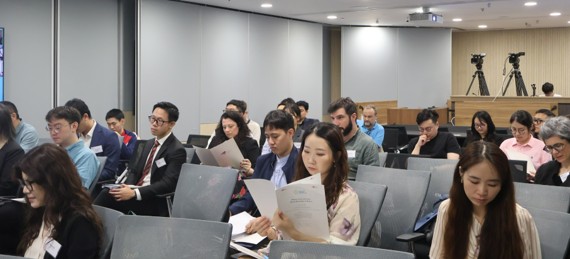
Participants included professors, early-career researchers, and practitioners, from all over the world, including Australia, Brazil, India, Rotterdam, Italy, Hong Kong, Macau, Singapore, US, China, Vietnam, and Israel. Various papers and presentations pushed the boundaries of private law in unexpected thought-provoking ways. Legal phenomena interrogated by participants included digital harm, climate crises, domestic violence, AI harms, cryptocurrency, securities fraud, and addictive technologies, while taking a broad view of private law’s potential and its overlapping boundaries with corporate law, public law, consumer law, and regulatory domains. The diversity of methodological approaches was also significant: while some presenters took case studies as their starting points, others used comparative methods, as well as empirical approaches, to address a range of problems.
Substantial engagement and cross-jurisdictional dialogue were sustained throughout the course of the two-day event, with ample time for audience feedback and drawing of connections between papers and panels. The ‘crisis’ of private law thus presents itself as an important moment in the field: exposing its current limitations while encouraging imaginative scholarship to take private law forward. A selection of thematically-linked papers is envisaged for publication as a special issue in the near future.
[The call for papers is closed] The City University of Hong Kong School of Law (CityUHK, SLW) and the Private Law Chapter of the Asian Law Schools Association (ALSA) are pleased to announce their inaugural in-person conference and call for papers on the theme: ‘Private Law in Crisis: From Doctrine to Policy’, scheduled to take place from 28-29 May 2026.
The conference welcomes contributions from established and earlier career academics and academic practitioners keen to explore this timely topic. The world has seen in recent years an unprecedented series of crises – global epidemics, climate change and environmental disasters, political and economic instability, massive inequality, a climate of misinformation as well as technology disruptions. These crises have challenged national and global policy-makers to develop innovative solutions to large-scale problems, and raised questions addressed by constitutional lawyers, international law academics, law and society, law and technology and environmental law experts.
In this regard, what role does the private lawyer, judge, or jurist play? Private lawyers are concerned with torts, contracts, restitution, property, and equity, sometimes depicted in individualistic and bilateral terms. Are such macro-scale questions beyond the remit of private law, being concerned with ‘policy’, poly-centric issues, governmental or regulatory expertise, and ‘public’ considerations? Or are traditional divisions of labour tested in such testing times? If so, what exactly is the contribution of private law? Could it involve novel applications of doctrines such as frustration or change of circumstances, or perhaps modifications and extensions of conventional concepts such as standing, rights, wrongs, liabilities, duties, causation, proximity and so forth? Or might it require us to think through novel schemes of regulation, including collective redress, loss-spreading and compensation, and regulatory solutions straddling private law, criminal law, and administrative law? Moreover, doctrinal and regulatory solutions to a particular problem may be addressed in different ways by different jurisdictions, allowing for comparative learning and cross-fertilisation of ideas and concepts. The possibilities for paradigm shifts are exciting as well as urgent.
Submission information
To submit an abstract for this conference (not more than 800 words), please email the organisers at [the submission page] by 30 November 2025. Please include a brief biography (up to 100 words) for each author.
Abstracts will be selected based on originality, fit with the theme and other papers, and indications of quality, with the aim of welcoming cross-jurisdictional diversity and dialogue. Final papers (not more than 10,000 words inclusive of footnotes) will be due by 30 April 2026. The organisers envisage that a selection of papers may be put together as an edited collection or special issue of a refereed journal, subject to quality of the contributions and the usual editing process.
Further information
Participation in the conference is free-of-charge. Participants bear their own costs for travel, accommodation, and local transportation. However, accommodation at the Royal Plaza Hotel and the Royal Park Hotel may be available at a discounted rate. Meals and refreshments will be kindly provided during the conference by City University School of Law.
For non-presenting participants interested in attending this event, please register at [the registration page] by 1 May 2026.
Organising Committee:
Professor Carrie DING Chunyan (CityUHK SLW)
Associate Professor Zhong Xing TAN (NUS Law)
Assistant Professor CHEN Yang (CityUHK SLW)
Assistant Professor HU Ying (NUS Law)
Assistant Professor Jeremiah LAU (NUS Law)
Assistant Professor TAN Weiming (NUS Law)
Advisory Panel:
Professor TAN Cheng Han (NUS Law)
Professor Lusina HO (HKU Law)
Professor James PENNER (NUS Law)
